How to Measure Your Retirement Portfolio Risk
Discover if You’re Taking Too Much Risk with Your Retirement Savings
Do you know how much risk you’re actually taking with your retirement savings?
Most people don’t. And that lack of knowledge could cost you hundreds of thousands of dollars.
When we ask new clients how much of their retirement savings they’re comfortable losing, they typically say something like 10%. But when we measure their actual portfolio risk, we often find they could lose 30% or more in a market downturn.
That disconnect between perception and reality is what makes measuring your retirement risk so crucial.
Why Measuring Risk Matters Now More Than Ever
The stock market has been on a remarkable run in recent years, reaching all-time highs multiple times. But history teaches us that bull markets don’t last forever.
When markets are rising, risk often hides in plain sight. It’s during major downturns that risk becomes painfully apparent—usually when it’s too late to protect yourself.
For retirees and pre-retirees, the stakes couldn’t be higher. Unlike younger investors, you don’t have decades to recover from significant losses. Your retirement security depends on protecting what you’ve already built.
The Retirement Risk Report
At B.O.S.S. Retirement Solutions, one of our most valuable tools is what we call the B.O.S.S. Retirement Risk Report. This comprehensive analysis measures your current portfolio risk and shows exactly how much you could lose in various market scenarios.
The process starts with a simple question: How much of your hard-earned retirement savings are you comfortable losing?
We then compare your answer to what your portfolio is actually positioned to lose. The gap between these two numbers often comes as a shock to our clients.
Real-World Risk Examples
Let’s look at some recent clients who discovered their retirement was at much greater risk than they realized.
We recently met a husband and wife in their early 70s who came to us for a second opinion. They’d been working with another advisor who kept telling them they were getting “great returns” on their investments.
When we ran our risk analysis, we found their portfolio scored 79 on a scale where 0 is the least risky and 100 is the most risky. For someone in their 70s, this was alarmingly high.
If a significant market downturn occurred, they could have lost over 30% of their retirement savings—far more than they were comfortable with.
They were stunned by this revelation. They had no idea they were taking so much risk, especially at their age when they should have been more conservatively positioned.
How Risk Is Measured
Professional risk measurement goes far beyond simple asset allocation models like “60/40 stocks and bonds.” True risk measurement examines how your specific investments would likely perform under various market conditions.
Our risk assessment looks at:
1. Correlation between your investments:
How do your different investments move in relation to each other? True diversification means having investments that don’t all move in the same direction at the same time. Plus many people have mutual funds or ETFs that are all invested in the exact same stocks, significantly increasing their risk if that stock turns down.
2. Historical performance during market stress:
How have your specific investments performed during previous market corrections and crashes?
3. Volatility measurements:
How much does your portfolio fluctuate in value during normal market conditions?
4. Downside risk:
What is the maximum loss your portfolio could reasonably experience in a severe market downturn?
5. Risk-adjusted returns:
Are you being properly compensated for the level of risk you’re taking?
This comprehensive approach gives you a much clearer picture of your actual risk exposure than simply looking at what percentage of your portfolio is in stocks versus bonds.
The Risk Number
Our risk assessment assigns your portfolio a specific “Risk Number” between 1 and 100, with higher numbers indicating more risk.
This number provides an easy way to understand your current risk level and compare it to your comfort level. It also allows us to track changes in your risk exposure over time and make adjustments as needed.
For example, a conservative retiree might have a personal risk comfort level around 25, while their actual portfolio might be positioned at 45. This gap represents a significant misalignment that needs to be addressed.
Conversely, someone who is comfortable with more risk might have a personal risk comfort level of 60, but their portfolio might only be positioned at 40. This person may be missing out on growth opportunities that align with their risk tolerance.
Bob and Carol’s Risk Reality Check
Consider the example of Bob and Carol, a couple who had saved $1,074,000 for retirement. They told us they weren’t comfortable losing more than 10% of their portfolio—about $107,400.
When we measured their actual risk exposure, we discovered their portfolio could lose over 32% in a significant market downturn. That’s $344,000 of their retirement savings at risk!
This massive disconnect between their risk comfort level and their actual risk exposure put their retirement security in jeopardy. A single bad market year could have devastated their retirement plans.
By adjusting their portfolio to match their risk comfort level, we were able to better protect their retirement savings while still generating the returns they needed.
Risk Doesn’t Just Affect Your Investment Balance
The impact of excessive risk goes beyond just seeing your account balance drop. For retirees, risk has additional consequences:
1. Forced lifestyle changes:
If your portfolio loses 30% of its value, you might need to significantly reduce your retirement spending or even return to work.
2. Sequence of returns risk:
If large losses occur early in your retirement while you’re withdrawing money, you can permanently damage your retirement security. This is because you’re selling investments at low prices, locking in losses.
3. Emotional stress:
Financial stress can take a significant toll on your health and relationships, especially during retirement when you should be enjoying life.
4. Legacy impact:
Excessive losses can dramatically reduce what you’re able to leave to your loved ones or favorite charities.
These considerations make proper risk management even more critical for retirees than it is for younger investors.
The Risk Blind Spots
Many retirement investors have significant blind spots when it comes to risk. Here are some of the most common ones:
Target date funds:
Many 401(k) participants invest in target date funds that automatically adjust their allocation based on their projected retirement date. While the concept is sound, these funds often take more risk than many pre-retirees and retirees are comfortable with.
Individual stocks:
Owning too much of any single stock—including your former employer’s stock—creates concentrated risk that could devastate your portfolio if that company struggles. This also happens when the mutual funds people are invested in have all purchased the same high-flying stocks, potentially causing all of their funds to drop in value when that stock’s price decreases.
Bond duration risk:
Many investors don’t realize that bonds can lose significant value when interest rates rise. Longer-duration bonds are particularly vulnerable to this risk.
Sector concentration:
Having too much exposure to a single market sector, like technology or healthcare, creates unnecessary risk even if you own many different stocks within that sector.
International exposure:
While international diversification is important, some portfolios have excessive exposure to emerging markets and other high-risk international investments.
A comprehensive risk assessment will identify these blind spots and help you address them before they can damage your retirement security.
You Can’t Manage What You Don’t Measure
The old management adage “you can’t manage what you don’t measure” applies perfectly to retirement risk.
Without properly measuring your risk exposure, you’re essentially flying blind with your retirement savings. You might think you’re being conservative when you’re actually taking excessive risk. Or you might be so cautious that you’re missing out on necessary growth opportunities.
Either scenario can jeopardize your retirement security. That’s why measuring your risk is the crucial first step in aligning your investments with your retirement goals.
How Often Should You Measure Risk?
Risk isn’t static. It changes over time based on market conditions, your portfolio composition, and your personal circumstances.
We recommend measuring your retirement risk:
- Annually: As part of your regular retirement planning review
- After major market movements: Both up and down
- Before retirement: As you transition from accumulation to distribution
- After major life changes: Such as inheritance, selling a business, or changes in health
- When contemplating large investment changes: Before making significant adjustments to your portfolio
These regular checkups ensure your risk exposure remains aligned with your comfort level and retirement goals.
The Risk Management Process
Once you’ve measured your risk, what comes next? At B.O.S.S. Retirement Solutions, we follow a systematic process:
- Identify the gap: Compare your risk comfort level to your actual risk exposure
- Adjust your portfolio: Realign your investments to match your risk comfort level
- Stress test: Ensure your adjusted portfolio can withstand various market scenarios
- Implement protection strategies: Add specific protections against major risks
- Monitor and adjust: Regularly review your risk exposure and make changes as needed
This process helps ensure your retirement investments remain aligned with your risk comfort level throughout retirement.
Protection Strategies for Retirement Risk
Once you’ve measured your risk, there are many strategies to bring it in line with your comfort level:
Proper diversification:
Beyond just stocks and bonds, diversify across asset classes, sectors, geographies, and investment styles.
Income-focused investing:
Emphasize investments that generate reliable income regardless of market performance.
Principal protection:
Consider strategies that offer downside protection while still providing growth potential.
Bucket strategies:
Segment your portfolio into short-term, medium-term, and long-term buckets with appropriate risk levels for each time horizon.
Guaranteed income sources:
Maximize Social Security benefits and consider other sources of guaranteed lifetime income.
The right mix of these strategies depends on your specific situation, goals, and risk comfort level.
Sleeping Well During Market Volatility
The ultimate goal of proper risk management isn’t just about numbers—it’s about peace of mind.
When markets become volatile, properly risk-aligned retirees can sleep peacefully, knowing their financial security isn’t in jeopardy. They don’t panic-sell at market bottoms or make emotional decisions that damage their long-term retirement security.
As one client told us after we realigned their portfolio with their risk comfort level: “For the first time in years, I don’t worry about checking my investments every day. I know we’re protected against what we can’t afford to lose, while still growing what we need for the future.”
That peace of mind is priceless, especially during retirement when you should be enjoying life rather than worrying about market fluctuations.
Take Action Now to Measure Your Risk
Don’t wait for the next market downturn to discover you’re taking too much risk with your retirement savings. By then, it could be too late to protect what you’ve worked so hard to build.
Instead, take proactive steps now to measure your current risk exposure and ensure it aligns with your comfort level and retirement goals.
At B.O.S.S. Retirement Solutions, our free customized B.O.S.S. Retirement Blueprint™ includes a comprehensive risk assessment that will show you exactly how much risk you’re currently taking and how well that aligns with your personal risk comfort level.
This process could help save tens of thousands, if not hundreds of thousands of dollars by protecting you from excessive risk while still providing the growth needed to maintain your lifestyle throughout retirement.
It’s easy to get started with your free B.O.S.S. Retirement Blueprint™. Just call 800-637-1031 to schedule your free analysis or click here to request your free B.O.S.S. Retirement Blueprint™. A call or click is all it takes to get started with your free B.O.S.S. Retirement Blueprint™.
Remember, retiring successfully doesn’t happen by accident—it starts with having a plan. And that plan is the B.O.S.S. Retirement Blueprint™.
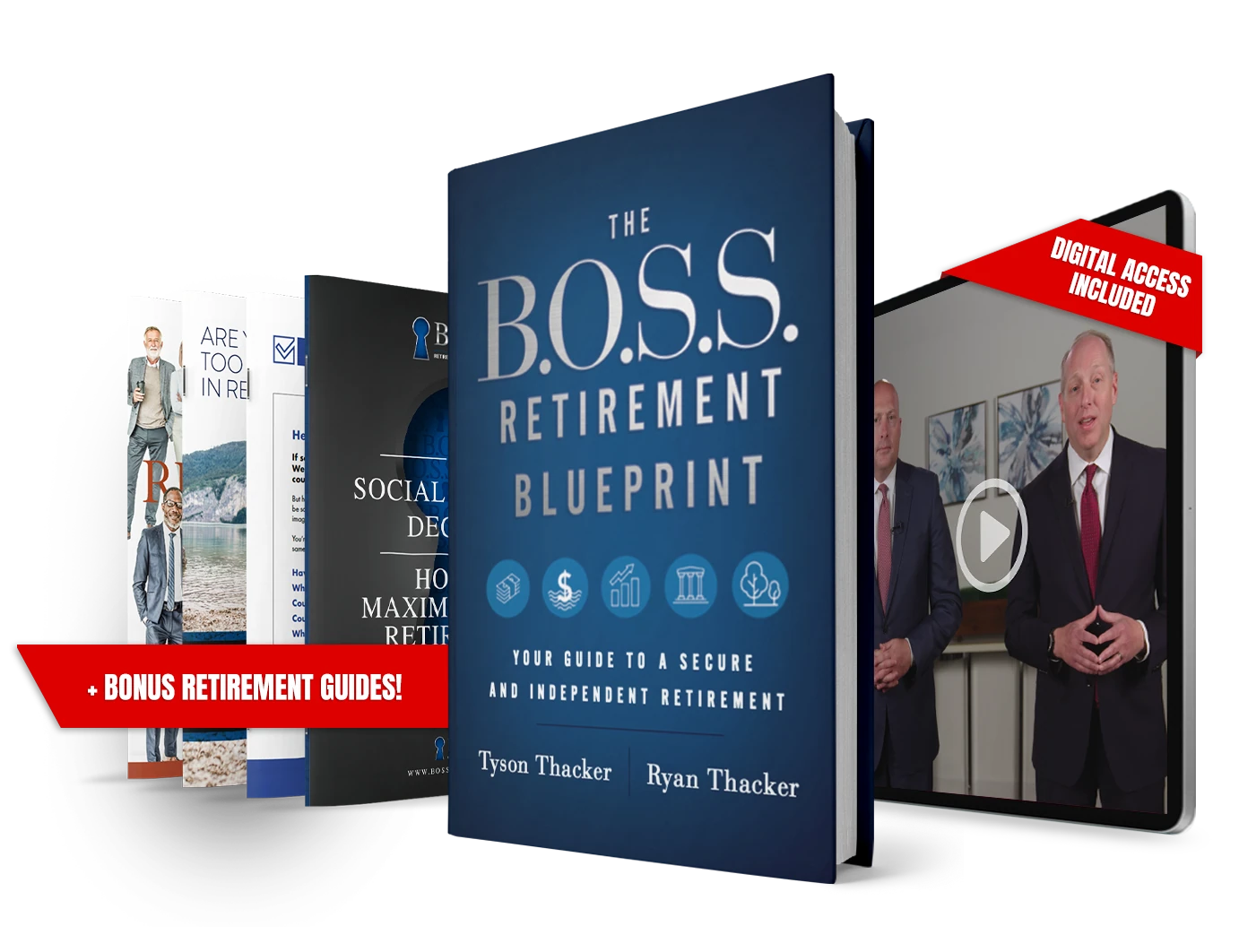
The Retirement You Deserve Starts Here
Request your complimentary retirement planning toolkit today!
Ready to Take The Next Step?
For more information about any of the products and services listed here, schedule a meeting today or register to attend a seminar.