
Building Wealth: Financial Lessons from a Retirement Income Expert
Each of us makes decisions during our lives, both good and bad, that have huge consequences when we reach the age of retirement.
In fact, most Americans could retire as millionaires if they made different choices in just a few key areas.
When it comes to building wealth, it’s not about complicated strategies or get-rich-quick schemes. It’s about math and science.
The True Meaning of Wealth
One of the biggest misconceptions young adults have about money is failing to recognize they’re already wealthy in ways they don’t realize.
Time is one of your greatest forms of wealth. The rule of 72 demonstrates this perfectly – divide 72 by your rate of return to find how quickly your money doubles.
At 1% interest, your money doubles in 72 years. At 10%, it doubles in just 7.2 years.
That $150,000 in your 401K can become $300,000, then $600,000, then $1.2 million, $2.4 million, and eventually $4.8 million over time.
You don’t build wealth overnight. You build it over 40, 50, or 60 years.
Wealth isn’t just financial. Physical health is wealth. Spiritual and emotional wealth matter too.
Stop Looking Wealthy and Start Building Wealth
One of the most important lessons for young savers who want to be millionaires is simple: stop trying to look wealthy.
You don’t need a brand-new Tesla at 24 years old. You don’t need fancy things right away.
Focus on becoming wealthy rather than trying to look wealthy.
Most Americans spend way too much on their cars. Consider this example: you can buy a brand-new pickup for $65,000 or a 2-year-old pickup for $30,000 with 13,000 miles.
If you buy the used one and invest that extra $35,000 at 6-8%, it grows to anywhere from $300,000 to $1.8 million over the next 30-50 years.
Multiply those savings across multiple vehicles purchased throughout your lifetime, and you’ll easily become a millionaire.
The Million-Dollar Car Mistake
Too many Americans are literally driving their million-dollar retirement down the road.
Don’t believe it? Take your car payment and put it into a time value of money calculator at 6-8% interest. Hit the button for 30, 40, or 50 years and see what it adds up to.
It will be multiple millions.
The problem isn’t just the purchase price. People forget about the total cost of ownership – insurance (which has skyrocketed lately), maintenance, and other expenses.
Put Your Money Into Appreciating Assets
The key principle is simple: put your money into appreciating assets, not depreciating ones.
Too many young people buy cars, boats, jet skis, handbags, shoes, and other items that lose value every day.
Worse, they take out loans to pay for these things, meaning they’re paying interest on items that are declining in value.
You will never get wealthy doing that.
Pay Yourself First
Many Americans think they don’t have enough money to save, but the reality is they’re just making wrong decisions.
Picture this: a household with a new pickup truck, a brand-new car, a couple of jet skis, an RV, and a satellite dish on the roof – yet they claim they have no money to save.
The solution isn’t complicated: prioritize differently and pay yourself first.
Before making a car payment, before paying insurance, save some money. That’s paying yourself first.
Why work so hard if you’re not getting anything for yourself?
Retirement Is Not Boring
Don’t believe the myth that retirement is boring. Financial freedom in retirement is like being a kid in a candy store.
Imagine having the freedom to join country clubs, travel extensively, and enjoy your passions without time constraints.
This is what retirement should be – financial freedom. Look forward to it with excitement and pay yourself first so you can get there and enjoy it.
Income vs. Assets in Retirement
For those in their 20s and 30s, focus on building wealth. When you reach your 40s and 50s, that’s when you should start seriously using income products.
Why? Because retirement is all about income, not assets.
Assets can be lost, stolen, swindled, sued for, divided in divorce, or decimated in a market crash.
The two critical factors in retirement are:
- How much guaranteed increasing income do you have?
- Have you taken the key retirement risks off the table?
The Power of Cash Value Life Insurance
Cash value life insurance is more than just life insurance – it’s an incredible asset class that does things no other asset can do.
It’s an excellent bond substitute and wealth-building tool. Wealthy people don’t have all their money in the stock market; they diversify with assets like Treasury bonds. A good cash value life insurance policy can pay more than those government bonds while providing a death benefit.
You can use your policy as your own bank. Imagine buying houses with cash by accessing your policy’s value, then paying your policy back.
For those working with a B.O.S.S. Retirement Solutions advisor, this strategy can be explored in detail. It’s not a do-it-yourself project – even financial experts work with professional advisors because products change frequently.
The Looming Tax Problem
Taxes are going to rise dramatically. With national debt at $35 trillion and the country paying $3 billion every morning in interest (over a trillion dollars annually), tax increases are inevitable and unsustainable.
Be very careful about putting too much money in a traditional 401k. While this strategy made sense for previous generations when taxes were high and expected to go down, that’s not today’s reality.
Taxes are going to increase in the future. How much sense does it make to get a tax deduction today, let money grow tax-deferred, only to pay potentially double the tax rate when you withdraw?
Contribute only up to the employer match in your 401k (because that’s a 100% return on investment). Beyond that, consider a Roth 401k, Roth IRA, or cash value life insurance.
Remember: with a traditional 401k, you’re not the sole owner. The government is your partner – the general partner who takes their cut first. You get whatever’s left over, and you have no idea how much they’ll take.
The highest marginal tax rate was over 70% for almost the entire 1900s, and there were many years when it exceeded 90%. It happened before and could happen again.
Tax Diversification is Key
When planning for retirement, you need more than asset diversification – you need tax diversification in your accounts.
By implementing these principles, you can enjoy retirement like you’ve always dreamed – golfing, traveling, and doing the things you love without financial worry.
Start With A Foundation of Financial Discipline
The one word that determines financial success more than any other is discipline.
Too many people prioritize the brand-new car, the Disney vacation, or the bigger house. Looking back at the end of life, these decisions often represent their biggest financial mistakes.
Instead, create a solid place to put your money. Ensure you have both asset diversification and tax diversification in your accounts.
We’ve helped thousands of families prepare and plan for their retirement, and we can confidently say this from experience: it doesn’t matter how much you’ve saved for retirement, it’s what you do with the money that really matters.
If you’ve saved a million dollars for retirement, a comprehensive plan could make that million act like two million. Without a plan, two million might only work like one million. That’s the impact a comprehensive financial game plan can have on your retirement savings.
Let’s make sure you have the best retirement plan for your unique situation. It all starts with a free customized B.O.S.S. Retirement Blueprint™. This process could help you save tens of thousands, if not hundreds of thousands of dollars in taxes in retirement. You’ll also discover strategies for ringing every nickel out of your Social Security benefits, plus so much more.
It’s easy to get started with your free B.O.S.S. Retirement Blueprint™ – just call 800-637-1031 and connect with a member of our team. You can also click here to request your free B.O.S.S. Retirement Blueprint™. A call or click is all it takes to get started with your free B.O.S.S. Retirement Blueprint™ today.
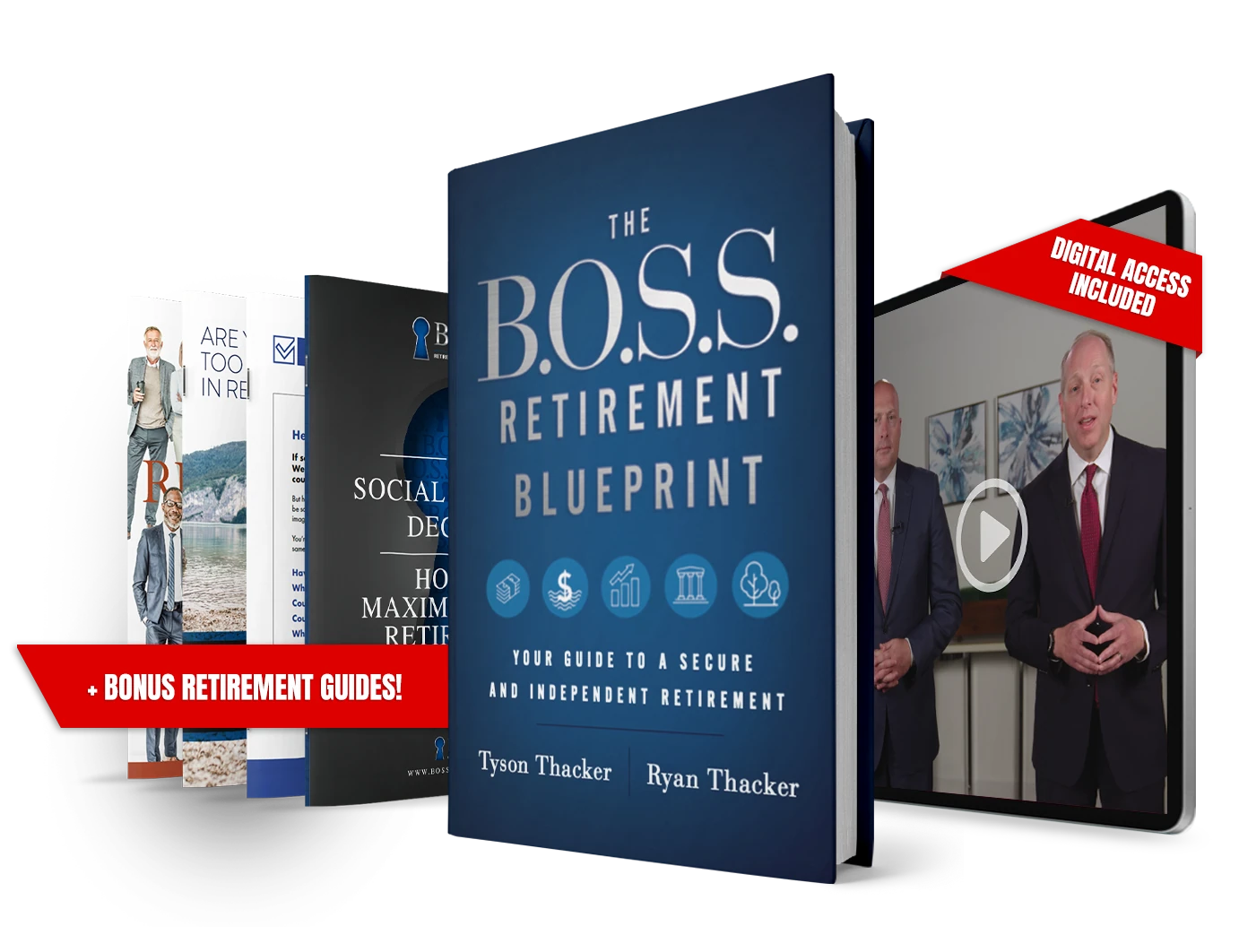
The Retirement You Deserve Starts Here
Request your complimentary retirement planning toolkit today!
Ready to Take The Next Step?
For more information about any of the products and services listed here, schedule a meeting today or register to attend a seminar.